


Introduction
Understanding an arithmetic sequence is one of the most important steps in learning mathematics, especially when dealing with patterns and number relationships. This concept forms the foundation for many advanced topics, making it essential for students and learners at all levels. Whether you are studying for exams or simply improving your math skills, mastering this concept can make a big difference.
An arithmetic sequence is not just a theoretical idea but something that appears in real-life situations more often than we realize. From financial calculations to everyday counting patterns, this concept helps simplify complex problems. By learning how it works, you can improve your problem-solving skills and build confidence in mathematics.
What Is an Arithmetic Sequence?
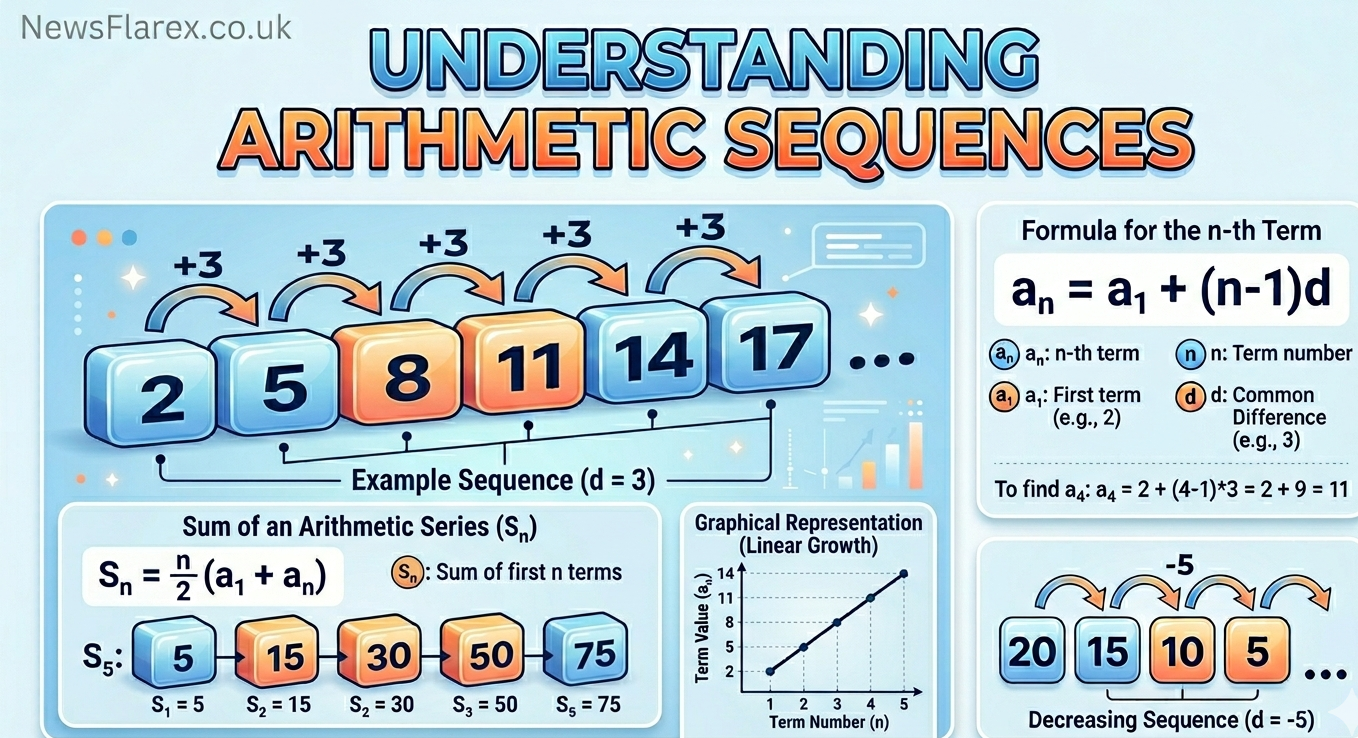
An arithmetic sequence is a sequence of numbers in which the difference between consecutive terms remains constant. This constant value is known as the common difference. For example, sequences like 2, 4, 6, 8 follow a fixed pattern.
The idea behind this mathematical pattern is simple but powerful. Once you understand how the pattern works, you can easily find missing terms or extend the sequence.
Understanding the Common Difference
The common difference is the key element that defines this number pattern. It represents the amount added or subtracted to move from one term to the next.
In every sequence of this type, identifying the common difference is the first step toward solving problems. It allows you to understand how values progress.
Arithmetic Sequence Formula and Its Importance
The formula of an arithmetic sequence is used to find any term in the sequence without listing all the previous terms. This makes calculations faster and more efficient, especially for large sequences.
a_n = a_1 + (n-1)d
This formula shows that every arithmetic sequence depends on three main elements: the first term, the position of the term, and the common difference. Understanding this relationship helps simplify even complex problems.
Real-Life Examples of Arithmetic Sequence
This mathematical pattern appears in many real-life situations where things increase or decrease in a steady and predictable way. One of the most common examples is saving money in a bank account where a fixed amount is added every week or month. For instance, if a person saves the same amount regularly, the total savings form a clear and consistent pattern over time. This helps in planning future expenses and understanding how savings will grow.
Another practical example can be seen in daily fitness routines, such as walking or running a fixed number of extra steps each day. If someone starts with a certain number of steps and increases it by the same amount daily, the progression becomes easy to track and measure. Similarly, in construction or architecture, evenly spaced designs like seats in a stadium or tiles on a floor also follow a structured pattern. These real-world situations show how mathematics naturally connects with everyday life and helps in making better decisions through predictable growth patterns.
How to Identify an Arithmetic Sequence
To identify this pattern, check whether the difference between consecutive numbers stays constant.
Once confirmed, solving becomes easier and more structured.
Applications in Mathematics and Beyond
This concept is widely used in mathematics, finance, and computer science.
It helps in predicting values, solving equations, and analyzing trends.
Common Mistakes to Avoid
While working with an arithmetic sequence, many learners make simple mistakes such as miscalculating the common difference or skipping terms incorrectly. These errors can lead to incorrect results.
To avoid mistakes in an arithmetic sequence, it is important to double-check calculations and understand the concept clearly. Practicing regularly can help improve accuracy and confidence.
Benefits of Learning Arithmetic Sequence
Learning an arithmetic sequence improves logical thinking and problem-solving skills. It helps students understand patterns and develop a structured approach to solving mathematical problems.
In addition, mastering an arithmetic sequence builds a strong foundation for advanced topics. It prepares learners for more complex concepts and enhances overall mathematical ability.
Conclusion
An arithmetic sequence is a simple yet powerful concept that plays a vital role in mathematics and everyday life. By understanding its principles, you can solve problems more efficiently and recognize patterns easily.
With consistent practice and a clear understanding, mastering an arithmetic sequence becomes achievable for anyone. It not only strengthens your math skills but also improves your ability to think logically and analytically.
You can explore more detailed explanations of mathematical sequences on this trusted educational resource.
