


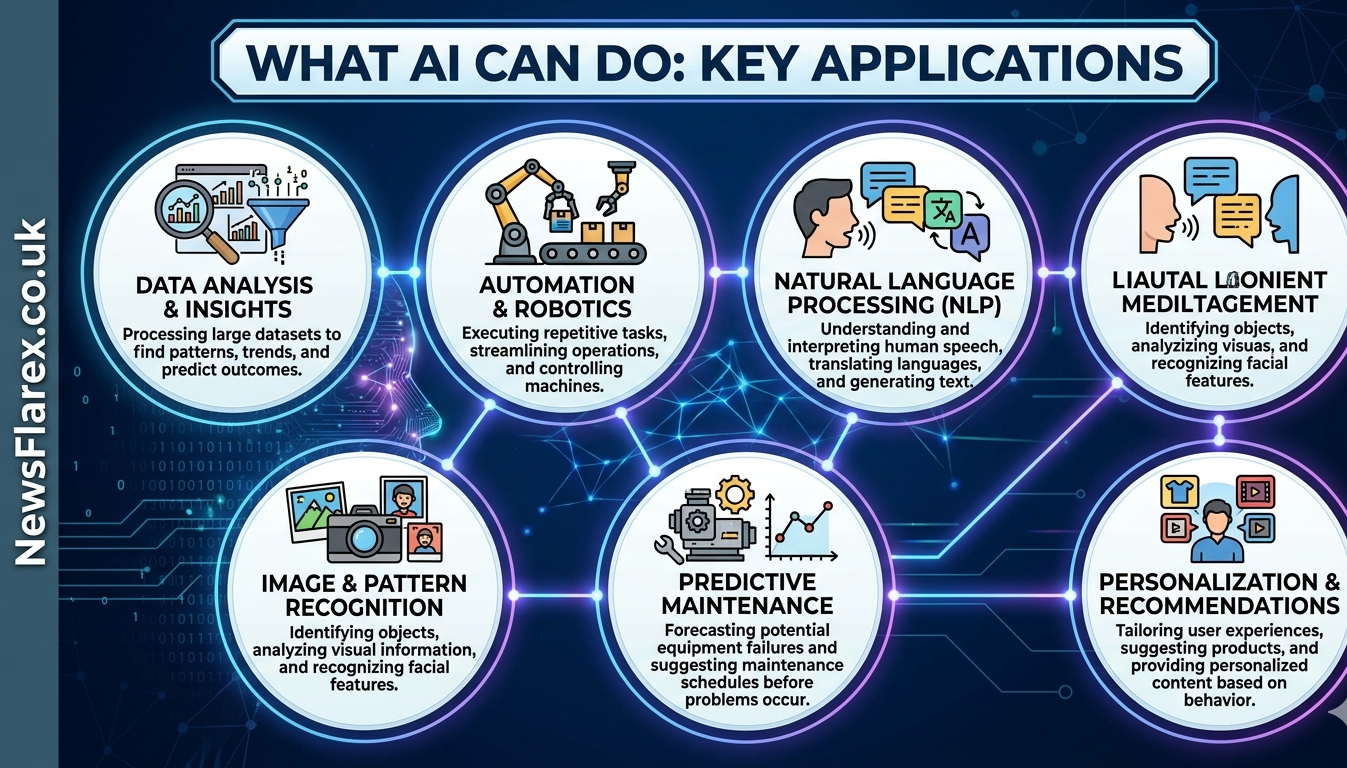
Artificial intelligence has evolved from a niche technological concept into a central pillar of the digital world. In 2026, AI is not just a supporting tool—it is a driving force behind innovation, productivity, and decision-making across nearly every industry. From automating repetitive tasks to enabling complex problem-solving, AI is reshaping how individuals and businesses operate in a data-driven environment.
The growing importance of AI comes from its ability to process massive amounts of information, learn from patterns, and continuously improve over time. Unlike traditional software, which follows fixed rules, AI systems can adapt and evolve, making them highly valuable in dynamic situations. Understanding what AI can do today is essential for anyone looking to stay relevant in a rapidly changing technological landscape.
Understanding Artificial Intelligence and Its Core Functions
Artificial intelligence refers to computer systems designed to mimic human intelligence, including learning, reasoning, and decision-making. These systems are powered by technologies such as machine learning, deep learning, and natural language processing. Together, these technologies allow AI to analyze data, recognize patterns, and generate insights without explicit programming for every scenario.
At its core, AI works by training models on large datasets. These models learn from examples and improve their performance over time. For instance, a machine learning model trained on thousands of images can learn to recognize objects with remarkable accuracy. This learning capability is what makes AI so powerful and versatile across different applications.
Modern AI systems have also become more advanced with the development of multimodal capabilities. This means they can process and understand different types of data, such as text, images, audio, and video simultaneously. As a result, AI can perform more complex tasks, such as generating videos from text or analyzing visual and textual information together.
AI in Everyday Life and Digital Platforms
AI has become deeply integrated into everyday life, often operating behind the scenes. Many digital services rely on AI to improve user experience, from search engines that deliver relevant results to email platforms that filter spam and suggest responses. These applications demonstrate how AI simplifies daily tasks and enhances convenience.
Personalization is one of the most visible uses of AI in digital platforms. Streaming services, social media platforms, and e-commerce websites use AI to recommend content and products based on user behavior. This not only improves user satisfaction but also increases engagement and efficiency.
Voice assistants and smart devices are another example of AI in daily life. These systems use natural language processing to understand and respond to user commands, making technology more accessible and intuitive. As AI continues to evolve, its presence in everyday tools is expected to grow even further.
AI in Business and Workflow Automation
Businesses are increasingly adopting AI to improve efficiency and reduce operational costs. AI-powered automation allows organizations to handle repetitive tasks quickly and accurately, freeing up human resources for more strategic activities. This shift is transforming how companies operate and compete in the global market.
One of the key applications of AI in business is document processing. AI systems can analyze contracts, invoices, and reports, extracting important information and identifying potential risks. This reduces the need for manual data entry and speeds up decision-making processes.
Customer service is another area where AI is making a significant impact. AI chatbots and virtual assistants can handle customer inquiries, provide support, and even complete transactions. These systems are available 24/7, improving response times and enhancing customer satisfaction while reducing operational costs.
AI in Healthcare and Medical Advancements
The healthcare industry has seen remarkable improvements due to AI. AI systems can analyze medical data, detect patterns, and assist doctors in diagnosing diseases more accurately. This has the potential to improve patient outcomes and reduce the burden on healthcare professionals.
Medical imaging is one of the most advanced applications of AI in healthcare. AI can analyze X-rays, MRIs, and CT scans to identify abnormalities such as tumors or fractures. In many cases, AI can detect issues earlier than traditional methods, enabling timely treatment and better results.
AI is also playing a crucial role in drug discovery and research. By analyzing vast amounts of biological data, AI can identify potential drug candidates and predict their effectiveness. This significantly reduces the time and cost required to develop new treatments, accelerating innovation in the medical field.
AI in Content Creation and Digital Marketing
Content creation is one of the most rapidly growing areas of AI application. AI tools can generate written content, design graphics, create videos, and even produce music. This has made content production faster, more efficient, and more accessible to individuals and businesses.
In digital marketing, AI is used to create personalized content, optimize campaigns, and analyze performance. AI-powered tools can generate blog posts, social media updates, and advertisements tailored to specific audiences. This helps businesses improve engagement and achieve better results.
AI also plays a role in search engine optimization by analyzing keywords, user intent, and content performance. This allows marketers to create more effective strategies and improve their online visibility. As AI continues to evolve, its role in content creation and marketing is expected to expand further.
AI in Data Analysis and Intelligent Decision-Making
Data is one of the most valuable resources in the modern world, and AI is the key to unlocking its potential. AI systems can process and analyze large datasets quickly, identifying trends and patterns that would be difficult for humans to detect.
In business, AI is used for predictive analytics, helping organizations forecast future trends and make informed decisions. For example, companies can use AI to predict customer behavior, optimize inventory, and improve supply chain management.
AI is also widely used in risk management and fraud detection. By analyzing transaction data, AI systems can identify unusual patterns and detect potential fraud. This improves security and helps organizations prevent financial losses.
AI in Education and Personalized Learning Experiences
Education is undergoing a transformation with the integration of AI. AI-powered platforms can provide personalized learning experiences, adapting content to meet the needs of individual students. This makes learning more effective and engaging.
Students can benefit from AI tutors that provide instant feedback and explanations. These systems can help learners understand complex topics and improve their skills at their own pace. This is particularly useful in remote and online learning environments.
Teachers also benefit from AI by automating administrative tasks such as grading and attendance tracking. This allows educators to focus more on teaching and interacting with students. As AI continues to develop, it has the potential to make education more accessible and inclusive.
AI in Automation, Robotics, and Smart Technologies
Automation is one of the most powerful capabilities of AI. By handling repetitive and time-consuming tasks, AI allows humans to focus on more complex and creative activities. This is particularly important in industries such as manufacturing, logistics, and transportation.
AI-powered robots are used in factories to perform tasks with high precision and efficiency. These robots can operate continuously, improving productivity and reducing costs. In logistics, AI systems are used to optimize routes, manage inventory, and improve delivery times.
Smart technologies, such as self-driving cars and intelligent home systems, are also powered by AI. These systems use sensors and data to make decisions and perform tasks autonomously. This represents a significant step toward more advanced and intelligent systems.
Limitations, Challenges, and Ethical Considerations of AI
Despite its many benefits, AI has limitations and challenges that must be addressed. One of the main limitations is that most AI systems are designed for specific tasks and cannot generalize beyond their training. This means they may struggle in unfamiliar situations.
Ethical concerns are also a major issue. AI systems can reflect biases present in their training data, leading to unfair or inaccurate outcomes. Ensuring fairness and transparency is essential for building trust in AI technologies.
Privacy is another concern, as AI often requires access to large amounts of data. Protecting user information and ensuring data security are critical for the responsible use of AI. Addressing these challenges is essential for the sustainable development of AI.
The Future of AI and Its Growing Influence
The future of AI is filled with possibilities. As technology continues to advance, AI systems are expected to become more intelligent, more adaptable, and more capable of handling complex tasks. This will further expand their role in various industries.
One of the key trends is the development of AI systems that can work more closely with humans. These systems will act as assistants, helping individuals and organizations achieve their goals more efficiently. This collaborative approach will enhance productivity and innovation.
AI is also expected to play a significant role in addressing global challenges, such as climate change, healthcare, and education. By providing data-driven insights and solutions, AI has the potential to make a positive impact on society.
Conclusion: Why Understanding AI Matters Today
Artificial intelligence has become a powerful and transformative technology that is reshaping the world. Its ability to learn, adapt, and generate insights makes it an essential tool in a wide range of applications, from business and healthcare to education and entertainment.
Understanding what AI can do is crucial for anyone looking to succeed in the modern world. By leveraging AI effectively, individuals and organizations can improve efficiency, drive innovation, and create new opportunities.
At the same time, it is important to use AI responsibly and address its challenges. By focusing on ethical practices and human-centered design, we can ensure that AI benefits society as a whole. As AI continues to evolve, its impact will only grow, making it one of the most important technologies of our time.
